Friday, 1 April 2011

Only Joking


Read all the questions before taking this test.

Cast your mind back to the days when you turned over exam papers at school.  Did you follow the above instruction? 

I didn’t.  I don’t think anyone else did either.  What was the point?  The exams were always in exactly the same format.  There were never any trick questions.  You just got started with question one.

Today, my teacher and I used this to pull an easy April Fool on our terminale class.  I created a double-sided test paper full of ridiculous questions with the instruction to read it all carefully before starting.  The last question ran, in English, “you don’t have to answer any questions on this test, it’s an April Fools’ Day joke.  Put your hand up, say you’ve finished and go next door.”  I went next door and waited.

The first girl turned up almost immediately.  She arrived so soon I was a bit concerned that they were all going to see through it.  I asked her whether the others were writing.  She nodded.  Another girl and a boy came in soon after.  He shook his head at me.  “That’s not funny,” he said.

The others began to turn up in drips and drabs.  I had them sit in the order they came in, while I sat there looking smug and revelling in my own cleverness.

After about fifteen minutes, they’d all come in.  I talked to them a bit about April Fools’ Day and what people do in England.  I mentioned some of the classic hoaxes such as the Panorama spaghetti trees and Sir Patrick Moore’s low gravity.  We then talked about some popular jokes such as “knock knock” and “an Englishman, an Irishman and a Scotsman” (apparently in France it’s the Belgians who are the butt of the joke).  They told me the French call 1st April “poisson d’avril”.  Other bloggers have covered what children mostly do here and here. 

I rounded off the lesson with a couple of videos starring Vicky Pollard and Del Boy.  I wanted to show others such as Fork Handles or Peep Show, but my internet’s so slow that anything longer than two minutes isn’t really doable.

I hope most of them saw the funny side.  They appreciated the sketches, but I think some of them would have been quite happy to wipe the smile off my face.  At the moment though, as Gap Yah guy would say, it’s 1-0. 

Wednesday, 23 March 2011

The Quaint Île Saint-Louis

Here's my plan for my life: finish university, pursue a long, distinguished and lucrative career as a writer, save prudently and invest wisely during those years and then use the money to retire to the île Saint-Louis the day after my sixty-second birthday.

All right, so it's more of a dream than a feasible plan.  What I am fairly sure of is that in forty years' time Saint-Louis will probably be much the same as is today: quaint, calm and delightful.

During the recent spell of glorious weather, I've been taking in the sunshine around the city.  One of my favourite places to walk is Saint-Louis.  With its narrow streets and bustling cafés "it's almost as if someone dropped a small French village into the center of Paris".  With no metro stations or major landmarks, it's calmer than its neighbour île de la Cité, perfect for a wander.

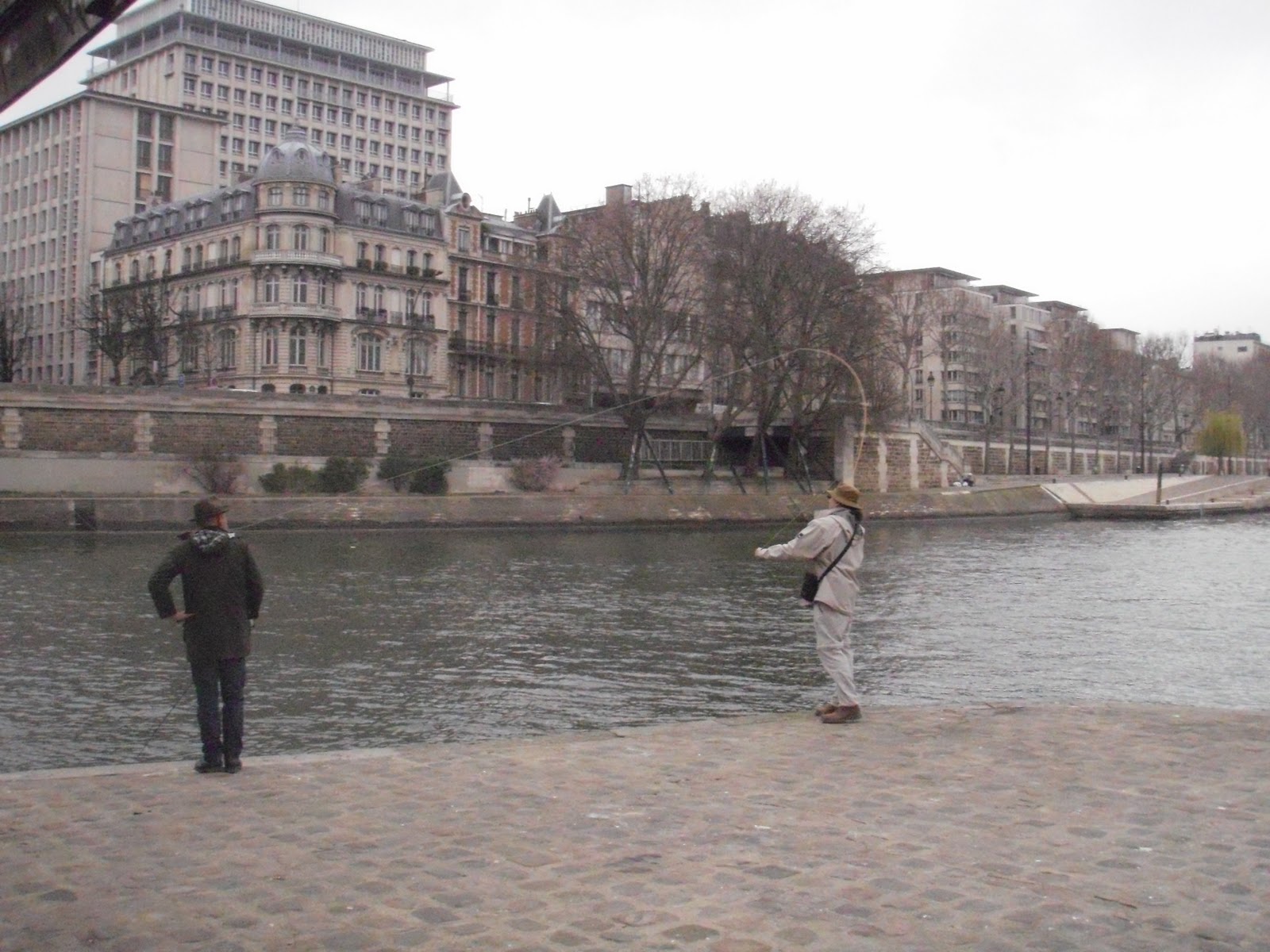
These two photos are ones I've taken of Saint-Louis.  One is of a saxophone player by the Pont Louis-Phillipe, the other is of two fishermen.


If you are tempted by life on the île Saint-Louis then have a look at this estate agent site where you can find the latest ads.  Sadly none of them are in my current price bracket, but maybe one day eh?

Friday, 4 March 2011

Palace of Versailles, part 2

Last Sunday I posted about the Palace of Versailles, focusing on the chateau itself.  After looking around the chateau, there was plenty left to see - including the Grand Trianon, the Petit Trianon, the hamlet and the enormous gardens.


You only really get an idea of the scale of Versailles when you are in its gardens.  As I said before, you are only shown around the most famous rooms of the palace, so it's only when you walk around outside that you get a sense of how enormous the complex is.

Looking out to the Grand Canal

I didn't stay too long in the gardens because it was a cold, overcast February day, so I headed to the Grand Trianon.
A pool in the gardens
The Trianons have a much lighter feel, and were often used by the royals to escape the strict etiquette of the chateau.  This room below was used by Louis XVI, and also was the drawing room of Napoleon Bonaparte.  He chilled out here when he wasn't conquering Europe:


The Petit Trianon became Marie Antoinette's domain and she extensively decorated it to suit her own tastes.  It was around here that allegedly (and I do emphasise that term) two ladies went through a "timeslip" back to when the Trianon was used by Marie herself.  For me however it remained the 21st century for the duration, as you can tell from the photo below:


Finally, I went to the Petit Hameau.  This was a model village that Marie Antoinette had built in the grounds, where she and her attendants would dress up and "play commoner".  I thought this was one of the most interesting parts of the whole day.  Walking around the immaculate lawns and perfectly "rustic" houses, it seemed sad to me that someone like the Queen, who had all the riches she could possibly want, would choose to milk cows and dress as a shepherdess in her spare time. 


On that note, a plus.

Sunday, 27 February 2011

Palace of Versailles, Part 1

I'm sure you've been all desperately wondering what I've been up to since I last posted about my weekend in Reims two weekends ago, so apologies for not filling you all in sooner.  I've actually been back to England for a while.  I stayed with my girlfriend, spent some time at home and visited my university town of Bristol for the first time since last June. 

I'm now back in France and this post continues the theme of visits to fine French historical buildings with a trip to the Palace of Versailles.

I don't suppose the palace needs a whole lot of introduction, but just in case it became the main residence of the French monarchy during the reign of Louis XIV.  Louis decided to build himself a magnificent palace on the site of an old hunting lodge at Versailles, conveniently close to Paris but distant enough for Louis to stamp his own mark on the royal court. 

The palace reached its peak of grandeur and importance during Louis XIV's reign, and was the home of the French royal family until 1789, when the events of the Revolution forced Louis and his family to relocate to the Tuileries Palace. 

Since then, it has changed hands several times during France's immensely confusing post-Revolution history, in which France has been a republic (several times), an empire, a partly-occupied territory and a monarchy.  Now that France is a settled republic, the chateau and its grounds are now a gigantic museum.  

The Hall of Mirrors
You can only look around a small part of the palace following a set route.  I guess this is because the palace is so huge that visitors would get lost if they were allowed to wander through the seven hundred rooms as they wished.  The route you take gives you its first "wow" moment with the palace's most famous room: the Hall of Mirrors.  Louis XIV used this room to entertain courtiers and guests, and it's easy to see why.  The entire room is a monument to Louis's power and wealth - the central painting on the ceiling is entitled le roi gouverne par lui-même (the king governs by himself). 

Peeking behind the royal covers
This next picture is of Louis's XIV royal bed.  The king was woken up by an attendant at around 7:30 a.m. and was washed and dressed.  Incredibly, he was watched through all this by a few close friends and courtiers.  No lie-ins for His Majesty.  The rest of the royal day was planned with equal care.  Louis XV and Louis XVI unsurprisingly hated the suffocating precision of the royal day, and the Levee became less frequent.


This is the Queen's bedroom.  Note the little door to the left of the bed: Marie Antoinette escaped through this door during the Revolution, when a mob of Versailles women stormed the palace demanding bread to eat.

The rear facade of the palace
I could go on with more pictures, but I think that's about enough on the palace.  Next up is the Grand Trianon, the Petit Trianon, the gardens and Marie Antoinette's model village, which will come soon.  Bye for now.

Monday, 14 February 2011

Weekend in Reims

Notre-Dame de Reims
Last weekend I went to visit my friend Samir.  He's an assistant who lives in Reims in the Champagne-Ardennes region of France.  He has a blog which you can read here

Reims is the largest town in the Champagne-Ardennes region in eastern France.  Many champagne houses have their headquarters in and around the city.  It's famous for its magnificent cathedral which was where many French kings were crowned from the Middle Ages onwards.  It also has a long history of confusing English speakers with the peculiar pronounciation of its name: in English it's pronounced "Reems" but in French it's something like "Rinz".

I got up far too early to catch the train from Gare de l'Est.  Bizarrely the cheapest fare for that train when I booked it was in first class, so I enjoyed the comfier chair and extra leg-room that brought as the TGV made its way through the countryside. 

After meeting Samir and two other friends we went to look around the cathedral.  It was almost deserted as it was early last Saturday.  A few dozen people were wandering around while recorded organ music played gently.  It was all very peaceful.
Looking towards the altar
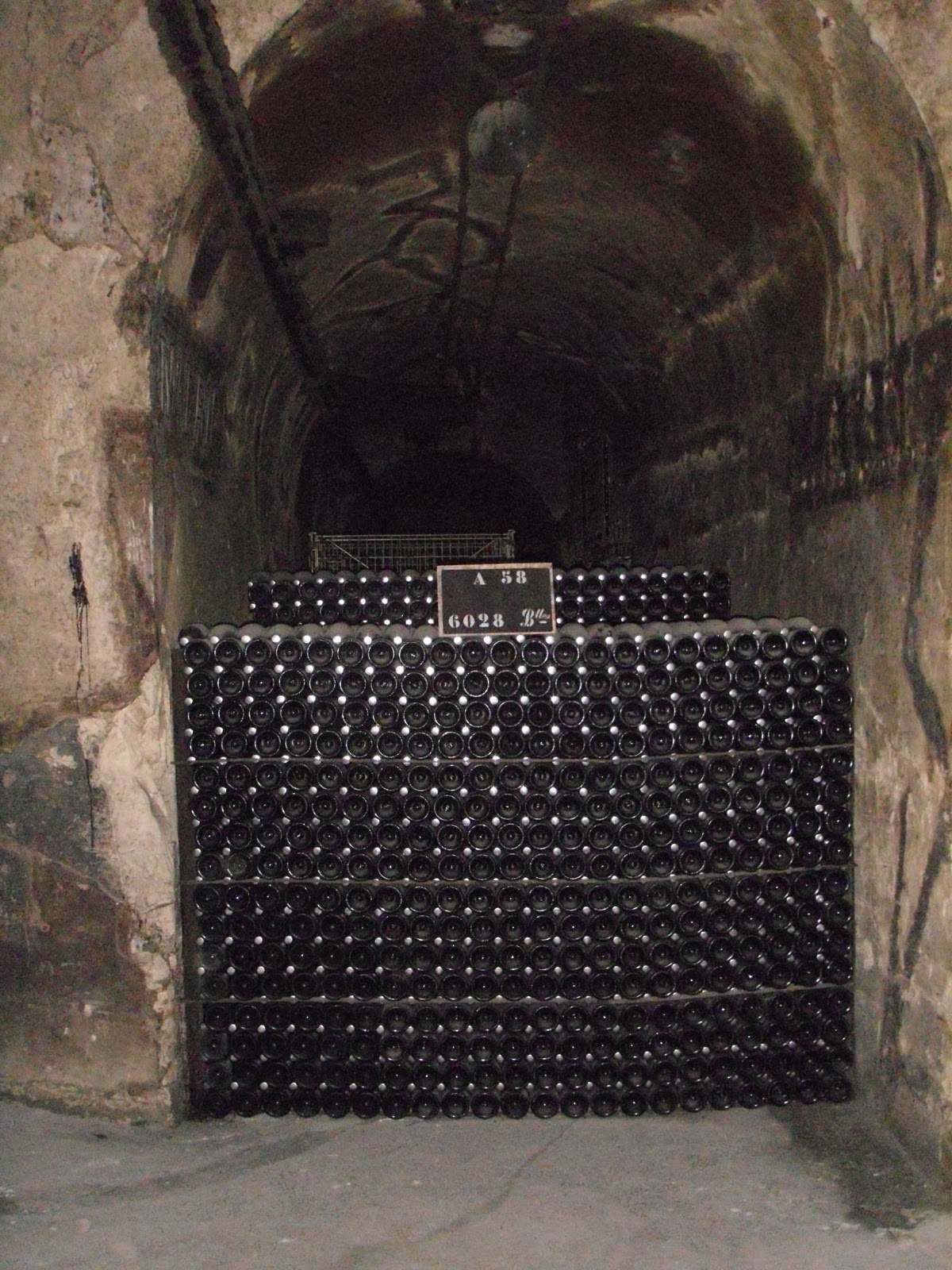
After that, we made our way to the Pommery champagne house for a tour.  We went down into the cellars where there are thousands of dusty bottles being left to age.  The guide explained to us the painstaking process of making the wine while we walked through various cellars marked "Manchester", "Hanover" and even "Bristol" - a "hangover" from the days when they tailor-made their blends to suit the customers in a particular city. 

I wonder how much all that's worth?
I asked the tour guide what he thought of Formula One drivers and FA Cup winners spraying champagne around.  He told me that often they cheat and use bottles that haven't matured properly so they can't actually be drunk. 

"They can waste their champagne, we drink ours," he said, cheerfully pouring a glass for the taster session at the end.

After that we went to a party, jointly hosted by Samir and a friend of his, which was a lot of fun.

Finally, another early start to catch a slower train back to Paris. 

Well done if you're still reading by this point, as this is probably the longest blog post I've ever done and it's completely off-topic.  That's all though, until next time.  Ciao.

Wednesday, 9 February 2011

Nouvel an chinois

The main parade on Avenue de Choisy

Last Sunday two friends and I went along to the Chinese New Year celebrations in the 13th arrondissement as it becomes the Year of the Rabbit.  Starting in the afternoon, there were parades, dances and general noise-making around Place d'Italie, Avenue de Choisy and the other streets that make up one of Paris's Asian districts.

At Place d'Italie you knew straight away that you were in the right place: there were decorations hanging from the streetlights and the appetising smell of Chinese food was in the air.  There were so many people lining the streets that it took a while to meet up with my friends.

By the time we had met it had become pleasantly noisy.  There were lots of people chattering, vendors selling things, drums and the periodic boom of a loud firecracker.  As well as the main parade there were smaller groups doing their own thing, such as these guys: 


After wandering around for a bit we decided to go to Tang Frères, the biggest Chinese supermarket in town to have a look at what was on offer, which was predictably rammed with people.  We ate and by that time the parade had begun to wind down.

I took home some food from a Chinese café including a chocolate roll (which has since been devoured) and Lychee, a tasty grape-like fruit.  A plus.

Monday, 7 February 2011

A Gargoyle's Perspective


There are several places you can go to get a great view of Paris. 

The Eiffel Tower is the obvious one as the tallest and most iconic building in Paris, if you don't mind waiting patiently in a long queue for the lifts to the top, or braving the stairs.

Another popular choice is the monolithic Tour Montparnasse.  The featureless tower sticks out like a sore thumb in the skyline so it's popular partly because, to paraphrase Maupassant, it's the only place in Paris where you can't see the damn thing from.

For location though it's hard to beat Notre Dame.  Slap bang in the middle of the city on the Ile de la Cité, it offers a spectacular panorama of the entire city. 

I climbed up its 387 steps with two friends the other day, and this photo is from a gargoyle's perspective at the top balcony connecting the two bell towers, looking north towards the Sacré-Coeur.